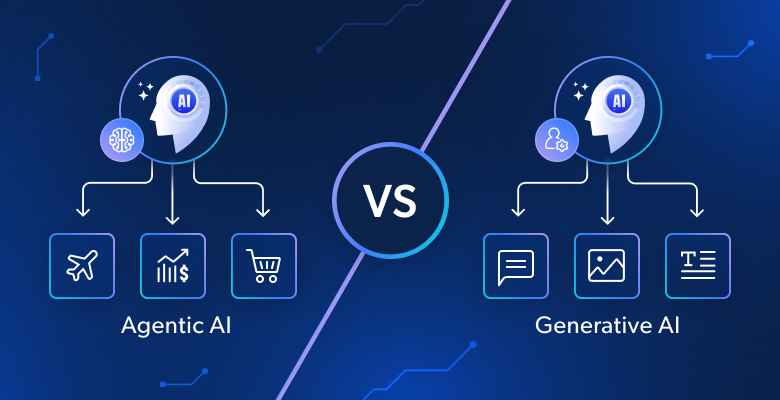
Artificial intelligence is undergoing a profound transition, one that promises to reshape industries and unlock opportunities at an unprecedented scale. We are moving from the era of generative AI, defined by its ability to create content in response to human prompts, to the dawn of agentic AI, where systems act with autonomy, intelligence, and purpose. This shift is not only a technological evolution but also a paradigm change in how AI integrates into business, society, and everyday life, demanding more innovative solutions to meet the unique requirements of these emerging workloads.
Agentic AI is beginning to power transformative applications across industries. Robotics is evolving rapidly, progressing from basic automation to highly capable autonomous agents in warehouses and manufacturing. Intelligent edge computing is being supercharged, enabling real-time decision-making for IoT deployments and smart city infrastructure. These examples highlight the growing influence of agentic AI, as it becomes central to achieving large-scale autonomy.
Market research underscores the speed of this shift. Gartner forecasts that by 2028, one-third of enterprise software applications will integrate agentic AI, compared to less than 1% in 2024. By then, 15% of routine workplace decisions are expected to be made autonomously. At CES 2025, NVIDIA CEO Jensen Huang echoed this trend, predicting that agentic AI will spark a new trillion-dollar industry and redefine the way people work. With its ability to perceive, decide, and act proactively, agentic AI represents a fundamental leap beyond the reactive nature of generative AI.
Generative AI’s impact is undeniable, captivating the world with its power to produce text, images, code, and media. Yet its limitations are clear—it is reactive, waiting for human input to respond. Agentic AI marks a step change, bringing true autonomy to machines. These systems can make decisions without explicit instructions, set strategies to achieve defined goals, and improve themselves through continuous interaction and learning. This evolution from passive generation to active execution unlocks broader and more impactful applications.
Already, agentic AI is becoming the driving force behind advanced technologies such as autonomous vehicles, robotic process automation, and intelligent healthcare assistants. Equipped with sensors and sophisticated algorithms, these systems perceive their environments, process data, and act purposefully. Consider an agentic AI–driven drone: instead of simply following commands, it can autonomously navigate around obstacles, optimize delivery routes, and adapt to unexpected conditions in real time—demonstrating intelligence without direct human supervision.
This transformation introduces new technical requirements. Generative AI depends heavily on data-intensive training and scalability of large models, emphasizing computational throughput and model optimization. Agentic AI, in contrast, requires systems to prioritize low latency, high reliability, and real-time responsiveness. As a result, memory bandwidth, memory latency, and overall system stability have become critical to ensuring efficiency.
Semiconductors are at the heart of this revolution. Advanced chips are no longer just components—they provide the compute power, efficiency, and reliability that agentic AI depends on. Among them, memory technologies are crucial enablers, feeding processing engines with the data needed to make rapid decisions. High-bandwidth solutions like HBM and GDDR are essential for handling massive data streams, while minimizing latency ensures responsive decision-making. As models grow in complexity, demand for higher capacity memory continues to rise, with DDR and LPDDR evolving to support more advanced workloads.
High-performance computing chips, from CPUs and GPUs to specialized accelerators, are also scaling to meet these demands. They increasingly rely on advanced packaging to improve integration, boost efficiency, and support the immense bandwidth and capacity agentic AI requires. Together, these innovations are pushing the limits of what AI systems can achieve.
The power of agentic AI lies in its ability to act, learn, and improve in ways that extend far beyond content generation. By driving autonomy across industries, from transportation and manufacturing to healthcare and smart infrastructure, it is poised to transform how we live and work. This shift marks not just the next phase of AI, but a redefinition of intelligence itself, setting the stage for breakthroughs that will ripple across society for years to come.