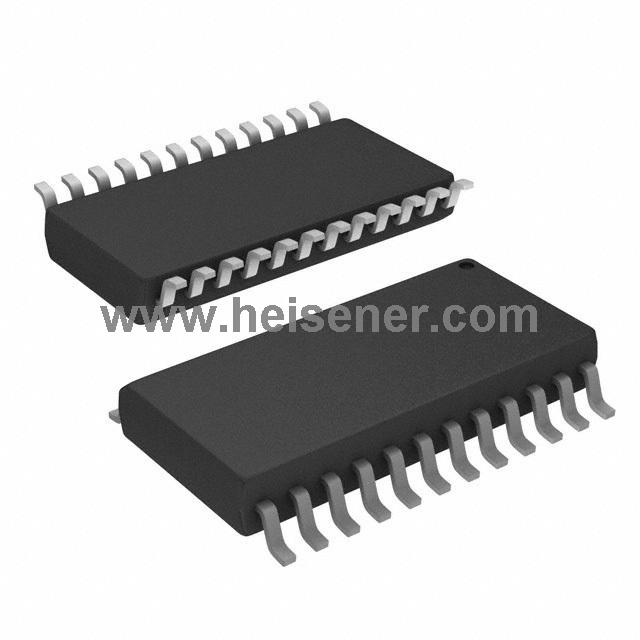
An amplifier is a device that increases the voltage or power of an input signal. It is typically composed of vacuum tubes or transistors, a power transformer, and other electronic components. Amplifiers are widely used in communication, broadcasting, radar, television, and automatic control systems. The amplification process is achieved by using the input signal to control energy from an external power source, which supplies the required output power. In linear amplifiers, the output signal is an amplified reproduction of the input signal, while in nonlinear amplifiers, the output has a specific functional relationship with the input.
Based on the physical quantity of the processed signal, amplifiers can be classified into mechanical, electromechanical, electronic, hydraulic, and pneumatic amplifiers, among which electronic amplifiers are the most widely used. Electronic amplifiers can further be categorized according to their active devices into vacuum tube amplifiers, transistor amplifiers, solid-state amplifiers, and magnetic amplifiers, with transistor amplifiers being the most commonly applied.
In automation instrumentation, transistor amplifiers are mainly used for voltage and current amplification. Common configurations include single-ended amplification and push-pull amplification. They are also used for impedance matching, signal isolation, current-to-voltage conversion, charge-to-voltage conversion (such as charge amplifiers), and functional operations (such as operational amplifiers).
Amplifiers can be classified according to different criteria:
By Type of Signal:
- Small Signal Amplifiers
- Large Signal Amplifiers
By Type of Configuration:
- Common Emitter
- Common Base
- Common Collector
By Classification (Operating Class):
- Class-A Amplifier
- Class-B Amplifier
- Class-AB Amplifier
- Class-C Amplifier
By Frequency of Operation:
- Direct Current (DC)
- Audio Frequencies (AF)
- VHF, UHF, and SHF frequency bands
Structurally, an amplifier can be viewed as a functional module containing an amplifying device, such as a Bipolar Junction Transistor (BJT), Field Effect Transistor (FET), or Operational Amplifier (Op-Amp). It typically has two input terminals and two output terminals (with ground as the common reference). The output signal amplitude is significantly greater than that of the input signal, achieved by utilizing power supplied from an external energy source.
An electronic amplifier is a device that boosts a weak electrical signal into a stronger one. Its main function is to increase the signal amplitude while preserving the waveform as much as possible without distortion.
Depending on what is being amplified, electronic amplifiers can be classified into:
Voltage amplifiers: primarily increase signal voltage;
Current amplifiers: primarily increase signal current;
Power amplifiers: increase both voltage and current to drive a load, such as a speaker or motor.
The operating modes and efficiency of electronic amplifiers are usually classified according to circuit design and biasing method into Class A, B, AB, and C. Different types are suited for different applications, including audio processing, RF communication, instrument measurement, and industrial control.
A power amplifier is a device that boosts the voltage or current of an input signal to a level sufficient to drive a load, such as a speaker, motor, or RF transmitter. Its core function is to convert a weak signal into a high-power output while maintaining waveform integrity.
Based on operating mode and efficiency, power amplifiers are typically classified as:
Class A: output nearly the full waveform, linear but low efficiency;
Class B: amplifies only half of the input waveform, higher efficiency but may produce crossover distortion;
Class AB: a compromise between linearity and efficiency;
Class C: mainly used for RF, high efficiency but strongly nonlinear.
High-frequency power amplifiers are mainly used in the final stage of transmitters to amplify already modulated high-frequency signals to the required power level. They do not generate energy but convert DC power from the supply into high-frequency AC power that is superimposed on the input signal, thereby increasing signal amplitude and power.
Essentially, they are energy conversion devices: by controlling the conduction of active components (such as transistors), supply energy is delivered to the load according to the input signal. Based on operating frequency range, they can be divided into:
Narrowband (tuned/resonant power amplifiers): use frequency-selective tuning circuits;
Wideband (untuned power amplifiers): use transmission-line transformers or wideband matching networks.
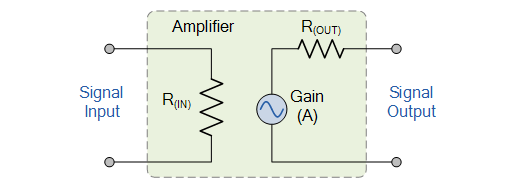
The gain of an amplifier refers to the ratio of output signal amplitude to input signal amplitude and measures how much the amplifier boosts a signal.
For example, if the input signal is 1 V and the output is 50 V, the gain is 50, which means the input signal is amplified 50 times. This amplification factor is called the gain.
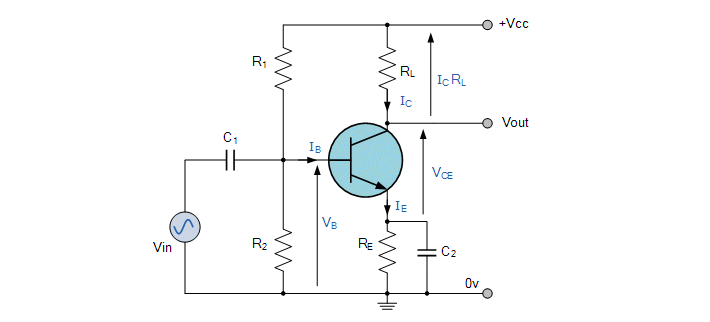
This is a classic Single-Stage Common Emitter Amplifier circuit.
The core principle of this circuit is to utilize the current amplification characteristic of an NPN transistor. A small AC input signal at Vin causes variations in the base current (IB), which in turn produces larger fluctuations in the collector current (IC). As a result, an amplified voltage signal is obtained at the output terminal Vout.
In the circuit, R1 and R2 form a voltage-divider bias network to ensure that the transistor operates in a stable linear region. The coupling capacitor C1 blocks the DC component from the signal source to prevent interference with the bias voltage. Meanwhile, the emitter resistor RE, together with the bypass capacitor C2, stabilizes the quiescent operating point and increases the AC gain.
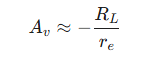
The voltage gain of the circuit is given by:
In modern audio systems, amplifiers with different channel counts meet different needs. The number of channels corresponds to the number of speakers and the system layout complexity.
2-channel amplifier and 3-channel amplifier
The 2-channel amplifier is the classic stereo setup. It is designed for Hi-Fi music lovers and drives the left and right main speakers, reproducing pure musical details. The 3-channel amplifier is often used in home theater front arrays. It adds a center channel to make movie dialogue clearer and more focused.
4-channel amplifier and 5-channel amplifier
The 4-channel amplifier is popular in car audio. It can drive front and rear speaker pairs at the same time. In home theaters, the 5-channel amplifier is the core of a 5.1 surround system. It covers left, right, center, and two surround channels, giving users an initial immersive audio experience.
6 channel amplifier to 8-channel amplifier
As systems upgrade to 7.1 or Atmos, multi-channel amplifiers become more important. The 6 amplifier offers flexible configurations, such as a 5.1 system with a passive subwoofer. The 7-channel amplifier can build a full 7.1 system, adding rear surround channels to eliminate dead spots in the sound field. For users seeking top performance, the 8-channel amplifier supports complex 7.1.x layouts. It can also use bi-amp mode to drive main speakers, delivering deeper and richer sound.